


San Leandro High is located in the California Bay Area, arguably one of the most climate conscious areas in the U.S. Yet it seems San Leandro High isn’t up to standard. Electricity, water usage, using sustainable products and recycling are four cornerstones to being climate conscious and yet, our school still uses non-renewable energy sources, faucets and toilets that waste water, and single use plastics, while not regularly turning in recyclable materials. Not only is this bad for the planet, it’s bad for our budget.
One way we can become more environmentally friendly at San Leandro High is to use less water. Our current bathrooms are fitted with push to start faucets and many have automatic flushers. The problem with both of these fixtures is that they tend to use water when no one needs it. The mass majority of our current faucets either don’t work or leak rendering them useless or costly because they’re wasting water. If we switch to handle faucets we will avoid them breaking and water waste. The same goes for flushers, automatic ones use motion sensors that more often than not are faulty, causing unneeded flushes. This is also a fact that bothers many of the students who use the bathrooms here at San Leandro High.
“Sometimes it won’t flush at all…[or] some of them flush like 50 times,” said Junior Alex Santos, “They’re inefficient, they waste water and they don’t work.”
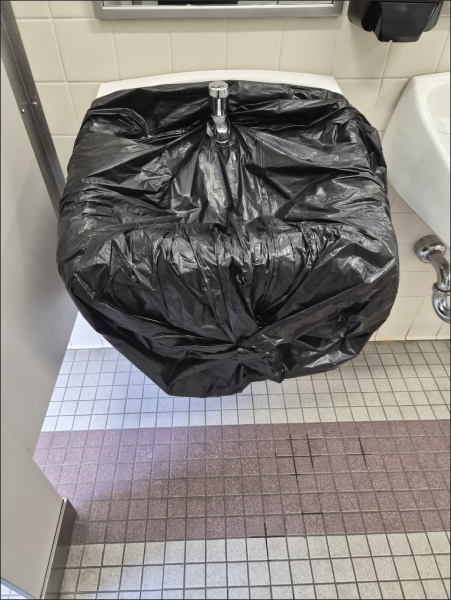
Switching to handle operated faucets and flushers will save water and electricity since there is no sensor to power and unneeded flushes won’t occur. The switch will also cause more functional bathrooms and happier students.
There is a simple change that San Leandro could make that will be better for the environment that is completely free, and has potential to make the school money: recycling. If we make an effort to properly dispose of plastic, cans and cardboard we can turn them in for CRV and get profit back that can go towards the school. We currently have recycle bins for plastics and cans in all classrooms and they are collected by janitors who bag them. The first problem with this however is that people tend to not take care when tossing away trash and the recyclables end-up mixed with garbage. The second thing is that collecting recyclables doesn’t do anything if they aren’t disposed of properly. Eco-Club Secretary Maya Elma said that once our contact with the city of San Leandro left, we were never reassigned someone to help us with things like proper disposal of recycling.
“The trash bags accumulated over a year, and we had probably, like, over 60 or 80 up there,” said Elma.
As a school we need to prioritize cost effective and sustainable measures to be taken.
On average, electricity is one of the largest expenses for schools, installing solar could easily save around $500,000 for our district. Due to how lucrative this is on top of how sustainable solar power is in comparison to nuclear, it is no surprise why we have added solar on the majority of our grounds. Currently, our school has solar on the roof of A, B and C hall, as well as a few free standing structures flanking the field.
Director of Buildings and Grounds, Nick Malve said, “An additional thing that’s going to occur, hopefully this summer, pending state approval, is the new gymnasium will be adding solar.”
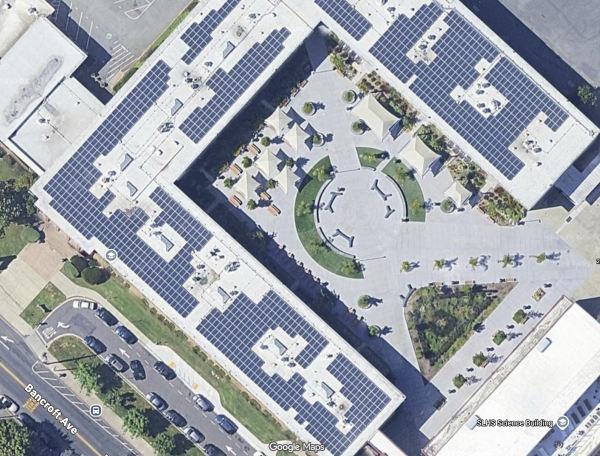
All of this naturally generated energy greatly supports our school in becoming environmentally conscious, as well as cost efficient, leaving us more of a budget to make greener decisions that positively impact the planet and our school.
One that we have already achieved is switching to wooden cutlery and serving meals in non-plastic containers. Both of these changes drastically lower our plastic consumption and push us towards a much greener campus. We can now compost everything that is provided from our free lunch, food scraps, wooden utensils and cardboard serving containers which can avoid the landfill and keep our planet clean. To do this we need more compost bins and a higher commitment to using them properly. If compostable items continuously end-up in the landfill their impact is substantially lowered.
The simplest thing we can do to make San Leandro High more sustainable is take solitary actions as students and teachers. We can carpool, use reusable water bottles and utensils at lunch, turn lights off when we leave an empty classroom, and if we do have to discard waste, do so correctly by ensuring food gets composted, cans get recycled and throw away only what needs to be trashed. We have to start somewhere if we want to make San Leandro High a greener place, and the starting point is our everyday choices until we can get funding to make larger changes.


