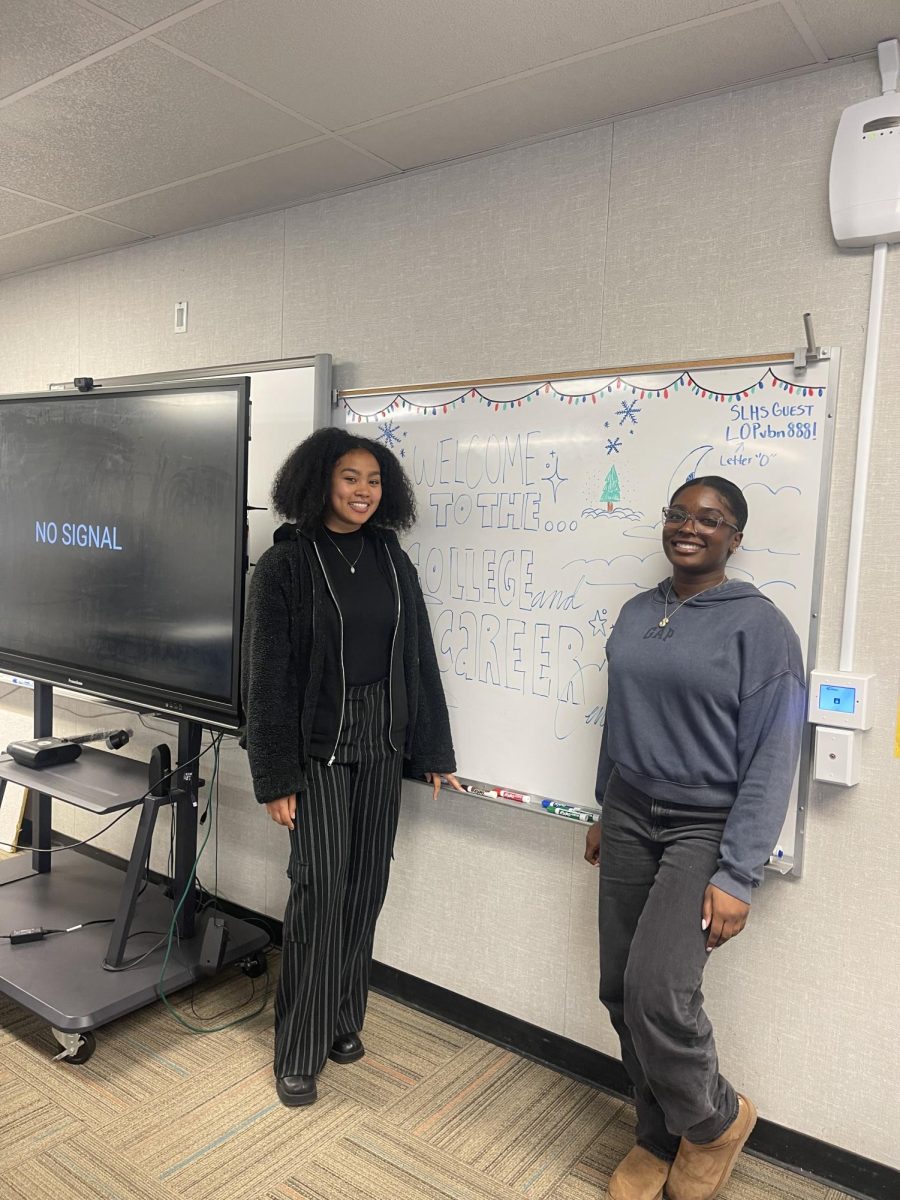


Students gathered in San Leandro High’s AEC to hear from author and educator Carolina Ixta as she returned to campus to discuss her newest novel, Few Blue Skies, and the real-world environmental issues that inspired it.
The event, organized by librarian Ms. Sasaki, marked Ixta’s second visit to San Leandro High. She previously visited to speak about her novel, Shut up, This is Serious.
Ixta was introduced by her former student, junior Fatima Valdez, who reflected on the lasting impact Ixta had on her as a teacher.
“She was my teacher in 5th grade, and over the years, we created a bond that led her to becoming a woman figure in my life, an inspiration from my younger sister and I,” said Valdez. “Her voice is important to young people like us because I feel like I learn a lot from her.”
Ixta, a 2014 graduate of San Leandro High, spoke about her journey from student to teacher and now a published author.
“I’m a bilingual educator down the street at Jefferson Elementary School,” said Ixta. “My first book came out in 2024, and this is my second book that came out like a couple of weeks ago.”
During her presentation, Ixta explained that Few Blue Skies focuses on environmental justice and takes place in a fictionalized version of Southern California’s Inland Empire.
“My godmother lived there and they’re experiencing a massive issue with air pollution and air quality there by way of a bunch of warehouses, which are factories that are set in places where mainly-Latino and black people live, so they’re forced to breathe in these really, terrible fumes from these diesel trucks that are passing by,” said Ixta. “They are more prone to asthma and lung cancer.”
Ixta said one of her main goals was to help young readers understand that injustice can take many different forms.
“All I wanted with this book was for children to understand that racism and issues of injustice are not just name calling or issues around segregation,” said Ixta. “I wanted to make sure it was presented in a way that was friendly, like in a young adult book.”
Ixta also spoke to students about the writing process and encouraged those interested in storytelling to start by simply writing.
“I think there’s a difference between writing and publishing,” said Ixta. “If you want to be a writer, literally all you have to do is write. You can literally write anything.”
She emphasized that reading widely is essential for writers who want to develop their voice and style.
“To be a writer, you have to read. You have to study what it is that you’re trying to produce,” Ixta said. “It’s like being a musician and never listening to other people’s music.”
Research was another key part of writing Few Blue Skies. Ixta said she read academic studies and interviewed dozens of residents living in communities affected by air pollution.
“I interviewed about 30 to 40 people about what it was like to live in the area, what air quality pollution was like, how it affected their children, how it affected their family planning, their schooling,” said Ixta. “It was a mix of active, active, active reading, active reading, of, I can’t just read, I have to highlight, I have to flag, I have to annotate.”
One story that stood out to her came from a woman who explained that the only way she could afford asthma inhalers was by traveling across the border.
“There’s one woman who told me that she chose to move to the area because it was close to the Mexico border, and the only way she could afford asthma inhalers was by going to Tijuana and then coming back because the price of inhalers were a lot more affordable down there,” said Ixta. “So, from talking to many people, I was able to gather textural details that I added to them [the characters].”
Despite balancing teaching, writing and traveling for book promotions, Ixta said she remains grateful for the opportunities her career has given her.
“There are some days where every minute of my day is accounted for, but I think about all the problems I could have in my life and I’m like, this is an inconsequential problem,” said Ixta. “But I think about the way that my grandparents grew up and the way that my mom raised me and my sister. It’s exhausting for sure, but I would pick this problem any day.”